
Why Your Content Is Working but Your Tables Are Still Empty
Let me start with saying that you’re not alone in feeling like this. Your engagement is finally going up with people liking, saving, and sending your posts to friends but your Tuesday nights are still feeling a bit empty.
Don’t worry, it’s not always a content problem, but something a lot more human than that.
The Gap Between “Meaning To” and “Actually Doing”
Let me introduce you to a studied psychological pattern called the Intention-Action Gap or sometimes called the Value-Action Gap. It describes the space between what people genuinely mean to do and what they tend to actually do.
Research on the Intention-Action Gap has found that a person’s stated intentions only account for about 30% of what they actually go on to do. Meaning, someone can look at your post, feel real interest, can even say “we should go there” to the person sitting next to them, and the odds are still stacked against that turning into a reservation.
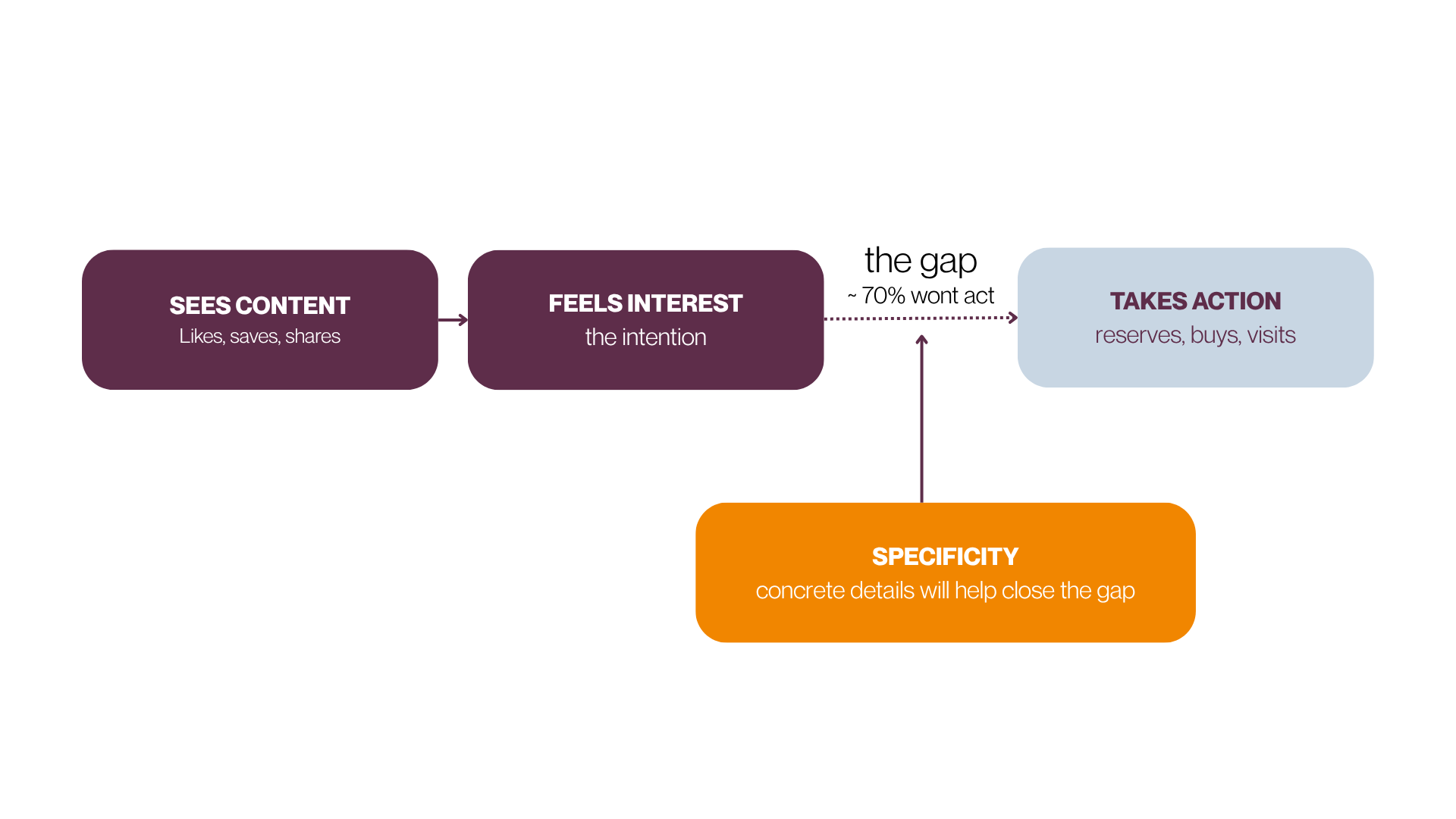
Wanting something and doing something are two different systems in the brain, and most of the time, the wanting part loses.
Research on saving behavior across platforms suggests that the act of saving something can function as a kind of psychological closure. The brain will treat the action of “I saved it” as “I’ve handled it”, meaning the very metric we treat as a trust signal can, ironically, be part of what lets someone off the hook from actually acting. That doesn’t make saves meaningless, as it’s still one of the strongest signals you have that something resonated, but it’s worth knowing that a save is a sign of resonance, and not a guarantee of them following through.
So What Can Close the Gap?
Not more content. Not a louder call to action.
What closes the gap is specificity.
There’s a concept in psychology called construal level theory, and the short version is that the more distant something feels, the more abstractly we think about it, like the big picture, the vibe, the “someday”. The closer something feels, the more concretely we think about it, like the actual details, the logistics, the reasons to act now instead of later.
Most hospitality content lives in the abstract. “Come experience something special”, “Check out our vibe”. That kind of language keeps a business feeling far away. It’s easy to like, easy to put off, easy to save for a someday that might not turn into any day.
What pulls someone out of a “maybe” and into “tonight” is specificity. A particular dish, a particular event, a particular reason this week that makes it different than any other week. Being specific isn’t so much a clever marketing trick, but it really is how the brain decides something is close enough, real enough, and urgent enough to act on.
What This Looks Like in Practice
Here’s where the practical part of the piece comes in because psychology without application is just theory, and you didn’t just come here for theory.
A strong, specific call to action does real work here. It’s not going to be the “check us out sometime,” but something a person can act on today. “Table for two, this Thursday, before the heirloom tomatoes run out.” Not “we’d love to see you,” but “ask for the corner booth, the view of the sunset will be perfect.”
The goal isn’t to convince someone your business is worth their time. If they’re liking and saving your content, they already believe that.
The goal is to give them one concrete, specific reason to choose tonight instead of someday.
The Takeaway
If your numbers look good and your tables still don’t, don’t take it as a sign to post more or to try harder to convince people you’re worth visiting. It’s a sign to get specific. Give people something real to act on, not just something to admire.
🍊At Farnsworth Street Marketing, community isn't a content strategy but is the foundation everything else we build on. If you're ready to turn your social media into something that reflects the community you've built, I'd love to hear about your business. Let's connect here.
